Tuesday, June 30, 2015

Book and Blog Post 10


After finishing the text I have a few things to say. First off, I never thought anyone could make the subject of social studies fun to teach. I have had plenty of social studies and history classes before and I could honestly say not one of them used the methods that were used in this book. 


Sarah Kartchner Clark not only wrote a masterpiece she also kept me interested in the entire book. I will definitely use most if not all the strategies that she laid out in the text.  There are very few books that I have read over the years that pertain to teaching that I could say I would hold on to; however this is one that will be in my classroom for years to come.
The author has been writing and publishing curriculum for over ten years and has written more than forty books throughout her career and it shows. The methods are well-thought-out, carefully planned, give great details for the teacher and offer tremendous insight to each lesson. 


The good thing about this book is even if you teach a subject other than social studies; you can find one specific to your content area of simply use this book and incorporate the subject that you teach.

I covered nine of the lessons in my post so far, but I haven’t even scratched the surface of what this book has in it. If you are a new teacher or someone who has been around the block like I have this is a must have.

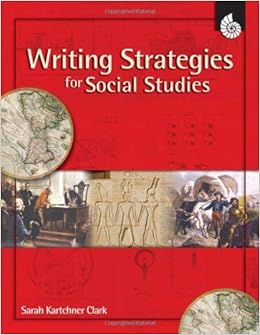
For a new teacher it will give you great examples of lessons to try in your classroom or if you a seasoned teacher it could help with the burnout that comes with years in the field. Either way I highly recommend this book. Feel free to ask any question regarding the text at any time I will be glad to answer them if I can. The title of the book is Writing Strategies for Social Studies by Sarah Kartchner Clark, the isbn is 978-1-4258-0058-1 and I picked it up from Amazon for around twenty-bucks. This has been a great way to examine areas of this text and look forward to hearing your feedback. Signing off. 

Book and Blog Post 9

Has anyone ever heard of a method called the RAFT Assignment? Before I read this section in the textbook I am reading I can say I never have. The link provided above will explain the method in complete detail; however, I will do my best to explain its importance as well. So here we go…
RAFT stands for Role, Audience, Format and Topic, the key ingredients of writing assignments (Santa, Havens, and Harrison 1996). 


What this assignment does is changes the normal assignment where the student writes a formal essay or report. The cool thing about this assignment is a teacher could alter the assignment to fit the content area whether it is English, Science or Social Studies. For example, in social studies a teacher could ask the students to “write from the point of view of a bill (role) speaking to a group of senators (audience) in a speech (format) about the process of the bill becoming a law (topic)” (Clark pg. 172). Here is an example of a handout that you could create using the insert tab in word:

RAFT Assignment
Directions: Use this prewriting planner to organize your RAFT assignment.


Role
Audience
Form
Topic


Reminders:
·         Think carefully about your role and your point of view.
·         Consider how to best communicate to your audience.
·         Use the traits of the writing form. You may wish to create a graphic organizer specific to that genre: for example, a letter, a poem explanation, or story.
·         Stay focused on your topic. (Clark, pg. 173).

Honestly, I have to say I am looking forward to trying this in my class this upcoming semester. I have always been a math teacher for the most part, but I was asked to teach a social studies class starting in August. I was completely worried that I would not have any ideas going in; however, as I keep reading this book and looking at the examples I have more confidence. I guess the moral of the story is I was stuck in a role that I was comfortable in and never considered doing anything different, but as a teacher one should expand their knowledge and this book has allowed me to do so.


Monday, June 29, 2015

Book and Blog Post 8

After Summarizing come the next method titled the “Guided Reading and Summarizing Procedure” or GRASP. This method allows the student to learn to recall, organize and self-correct before composing a summary through teacher modeling. (Clark) The idea is both the students and the teacher provide a summary in which both their ideas will be compared and contrasted. What this does is allow the students to see the teacher’s perspective on the piece and at the same time reinforces the learning that the teacher wants to implement on the class.
This process has some flaws including students becoming subjective to bias, but if the teacher doesn’t dominate the discussion or try to change the opinion of the students then it can work. According to Ryder and Graves (2003) “[if] the teacher revise his or her summary based on the students’ suggestions and make a visible record of these changes [this will] make the revision process more concrete for the student.” This scenario will show the student that the teacher is open and values their opinion on the topic and promotes positive transfer and reinforcement.
The whole idea behind this is a good one because students want to feel valued and incorporated in the lesson and this shows them that the teacher is human as well. It reminds me of a time where I made a mistake during a math lesson. As a teacher, sometimes you feel invincible and making a mistake could be devastating, but on this particular day a student told me made this mistake. Boy did I feel uneasy, but I told the students that making mistakes is part of learning and even teachers make them. This showed them that I was not superior because I was the teacher and made the lesson more enjoyable.
The important part of teaching is to make the students feel comfortable and to promote a healthy learning environment. This exercise promotes this concept, because the students put forth the effort to suggest better ways to summarize the piece and at the same time it shows them that their opinion matters.
If you would like to incorporate this lesson in your classroom here are some tips:

After the reading in their social studies book is finished, have the students share what they remember. Write down what was remembered on the board and then instruct the students back to re-reading the text for a second time. Have the students look for any valuable information that may have been missed. This will reinforce the learning because it will open the students mind and allow them to look at the text differently.  Once this is complete you can have the students write their summary in class or for homework. 

Book and Blog Post 7

Summarizing…Harder that it sounds right? What does summarizing do for a student is the better question. Clark tells us that “summarizing improves readers’ abilities to locate the main ideas and supporting details, identify and omit unnecessary details and redundant materials, remember what is read, analyze text structure and see how the ideas are related, generalize details, clarify meaning, take notes and rethink what they read so they can process it more deeply” (pg.153). 

What? A lot more detail than I originally thought it would entail. So is the ability to summarize a lost art? Not exactly the whole idea of summarizing gets disconnected from the teacher to the student; but, a good teacher explains the method in a way that is understandable to the student.


“Summarizing is when the student summarizes the reading, and extracts the most important information and turns it into wording that s/he understands” (Duran). This statement uses less confusing terminology and basically suggests the same thing. The student reads the text, writes down what s/he thinks it means in her/his own words. See what I mean it gets easier, Right? So, you might be thinking there has to be steps…Right? And the answer is YES! Here we go:
Students need to remember three important elements to summarize effectively (Clark):
1.       Keep the information brief
2.       Identify the most important ideas
3.       Mention some supporting details

This, my friends are three easy steps to assure student success in the summarization process. Of course, students learn in different ways, so how can a teacher relate the process to those who learn differently? The answer to this question is up to the teacher. S/he could adjust the lecture on their own opinion of how to relate it back to the student. As a teacher, we all need to adapt to situations as they occur, so instruction is based on case-specific scenarios. I hope this post helps…until next-time!


Book and Blog Post 6

Another blog! Yeah! Today we will examine a concept known as the Reader-Response Writing Chart (Carey-Web, 2001). This concept is designed to ask students what both they and the author of the text bring to the passage while in a social studies class. When writing expository social studies pieces, students need to try to remain neutral and focus on the facts, data and research. (Clark) 


To elaborate, students will need to establish a clear point of view when writing in social studies and this strategy will allow students to become more aware of any bias that they may have and what writing are acceptable to use them bias’. This would be an example of a chart used to distribute to your students:


The Author
The Student
Mountain Men traveled all over the Northwest part of the United States long before the settlers arrived. The settlement in Oregon did not begin until 1834. The Oregon trail led the way to the Northwest and the wagons began to come.
I think the Men were settlers. They should have given credit for being the first settlers in the area. They may not have built the homes but the lived there first. They knew the area better than anyone.


For the teacher: The left side is where the students would write the author’s point of view of the topic along with any examples of bias or prejudice that the student feels the author may have in the piece. If you are working with older students a good practice would be to ask the students to gather proof of the bias or prejudice from the text and write it in the right column. Along with the chart, you can ask guided questions including:


1.       What do you know about the subject?
2.       What are your feelings about this topic?
3.       Have your read anything about this topic before?
4.       What do you think about this topic?
5.       Do you think the author has preconceptions (an idea or opinion formed in advance) about this topic?


These questions will help the students determine the value of the author’s opinion on the topic and allow the students to eliminate their biases that they may have. The final part to this method would be to ask the students to record whether or not their views have changed after reading the piece and if so, have them document the change. 

Friday, June 26, 2015

Book and Blog Post 5


After going through the next five sections of the textbook I have noticed a variety of ways to incorporate journal in the classroom. This text seems to be redundant at this point and  methods are all the somewhat same, but all have different names. However, after overlooking the similarities, I have never really realized the importance of incorporating journal in the classroom. One method is called Critical Incident Journal[ing] (Clark). This method is used in order to key in on one particular event in the class. The text describes it as a “aha! Moment, when a student finally understood the material [or] the confusing part of the lesson” (Clark).

 I have never experienced this in a English class, but I have seen many aha! Moments during my years of teaching math. The text gives some example questions that a teacher could relay to the students on a worksheet:
1.       What is the significant event you would like to write about in your journal?
2.       Why is this event important to you? What was your favorite or least favorite part of today’s lesson?
3.       Describe the event. What happened?
4.       What did you learn from this experience?
5.       How does it fit in with what you are learning in social studies class?

These kinds of guided questions can be incorporated in any subject and can be quite beneficial because it allows the students to describe in detail of what occurred during the lesson.
The next form of Journaling the book describes is called a Dialog Journal. A “Dialog Journal is just what the name implies […] a dialog between two or more people. Dialog Journals can be shared between a student and a teacher or a student and another student” (Clark). This is a valuable exercise that will benefit the student now and in the future and at the same time allow the teacher to see how the student comprehends the material. So, in a sense it’s a win, win.


As I continue to read this book I hope to learn other methods to use in my classroom. So far it has been a good help and has allowed me to look at things differently and open my mind to using different ways of reaching the students. At this point I will continue to read and post anything that could be valuable.


Thursday, June 25, 2015

Book and Blog Post 4

How important is note taking? EXTREMELY! The reality is people are note-taking every class, in every meeting, and in everyday activities. But what separates a good note-taker from a bad one? A good note-taker understands what is the relevant information being discussed, while the bad note-taker is not engaged in the lecture or presentation.


 What it comes down to is how far you want to go in the class that you are taking or how far you want to advance in the workplace. If a student is precise in his/her note-taking… well you do the math. Clark explains, “Note taking is a crucial skill for students in upper elementary grades and beyond. High school and college students do a significant amount of note taking during classes and while reading” (98). Makes complete sense…right? As a college student how much time did you spend writing notes, revising them, studying them and regurgitating them when it became exam time?


Note-taking is also a valuable research skill to have. If a student is proficient in the skill s/he will be more likely to organize information and understand the importance of what was discussed. So now that we discussed the student’s role…what can the teacher do to reinforce note-taking as a valuable skill? Well to start off, the teacher should teach students with a “clear explanation, teacher modeling, guided practice ad explicit feedback” (Clark). What this means is, students must demonstrate proficiency before the teacher can expect them to perform independently.


As a teacher one should guide the students every step of the way so they [the student] will understand the importance while making it a necessity rather than a chore. Because what kid likes chores?
“To extend the value of note-taking, teachers can show students how to use their notes to apply new knowledge” (Clark). With that said for a teacher what’s better than gaining new knowledge and expanding a student’s vocabulary? That’s the ultimate goal for a teacher, for a student to get it and then apply it. Mastery is key while note-taking can we all agree? I will leave you with this statement:

If teachers can make the connection…the students can demonstrate their knowledge. 


Wednesday, June 24, 2015

Book and Blog Entry 3

Blah…Blah…Blog! Another day another lesson to be learned! I love it! Today’s blog has a method that can be used for students to learn the terminology in social studies more effectively. We start with a method called “Key Phrase Journal[ing].” The Key Phrase Journal (Brindle and Hatcher 1996) is used to assist students by incorporating new social studies vocabulary and terminology into the students writing. To begin, a teacher would used some of the key words during the social studies lesson and ask the students to use the terms as a journal entry.

By incorporating this strategy into a lesson on a regular basis this allows the students to develop a concrete understanding of the terms being used and in turn the students will be more willing to use them in writing. In order to get better results (my personal opinion) a teacher should use this method during a reading section of the class and ask the students to generate words that they felt were confusing or needed more clarity. This will allow the students time to think about these words and research the how and why associated with the terms.
An example from the text book that I am reading goes as follows:
Key Words:
Code of Hammurabi, gods, rules, punishments, preserved, Babylonia, ancient times
Journal Entry:
The Code of Hammurabi is one of the best preserved sets of laws from ancient times. It lists the rules of the Babylonian society. The punishments ranged from small fines to death. Hammurabi wrote the set of laws to please the gods.

This is a fantastic example of how a student could journal. It incorporates all the key terms and puts them into a few sentences that make them easy to remember.
Another way to incorporate this method into a lesson would be to pre-determine what words you (the teacher) might feel the students would struggle with and address those terms throughout the lesson. Clark suggests, “Throughout the reading lesson or activity, introduce the words and use them in sentences or point them out in the text. Discuss the meanings of the words with the students. After the lesson, or later that day, write the list of words and phrases on the board and instruct the students to write an entry in their journals using those words” (Clark, 85).

By following this method in its entirety, a teacher can allow the students to utilize several aspects needed to understand the confusing terms and in turn promote a better learning environment within the class room. If the students practice this method on a regular basis, they will be able to understand the concepts easier and make a somewhat boring subject more enjoyable.


Tuesday, June 23, 2015

Book and Blog post 2

This book has great ideas! One of these ideas for incorporating writing strategies in social studies is called "List-Group-Label" This strategy allows the teacher to encourage brainstorming in order to categorize and organize the vocabulary and in turn relate it to the text in which is discussed. As the students utilize this method, they combine their prior knowledge of the concepts with help from the teacher and put the information into categories. Clark sates, "[because] most words are associated with other words [,] grouping these words in meaningful ways clarifies understanding of words and their meanings " (32).What this activity does is allows students to utilize their previous knowledge of the words and take that knowledge in order gain a better understanding of the new vocabulary that has been introduced. Pretty cool huh? 

Now let's see this method in action. First write a word or phrase on the whiteboard. Allow the students to think of words that could be associated with this word and write them down on the board. After the word list is generated, ask the students to explain what connects occur to each word. This part of the process will help eliminate any words that are unrelated to that key words.  Here's an example of a template that you could generate and hand out to your students: 


After the words are categorized and the other words are eliminated, allow the students to share their versions of the categories and organization of the vocabulary words. This will allow time for a group discussion in order to agree on the words and their relation to one another. This method could be quite beneficial because it promotes brainstorming, the students are engaged in the concepts and they develop a relationship within the terms. 


In order to gain a better understanding of the terms used in a social studies class the textbook suggests another method called "Vocabulary Self-Collection." This strategy allows the students to create a list of vocabulary words that the student is interested in learning the meanings more in depth. This method requires the student to do the necessary research to define the word in his/her own words. By the student researching these words they will gain more exposure to the words and in turn their vocabulary will increase and the student will become more aware of the words and their meanings (Clark). 

Both of these methods will allow your students to be more engaged in the vocabulary of social studies. It promotes better study habits such as researching, brainstorming and the ability to expand one's vocabulary and there is nothing more rewarding to a teacher than knowing his/her students are gaining the proper knowledge needed to achieve success. If used correctly, these methods will prove to be a necessity for an aspiring young teacher in the content field. 


Monday, June 22, 2015

Book and Blog Post 1

http://ecx.images-amazon.com/images/I/51Febr7XQnL._SX258_BO1,204,203,200_.jpgAhh…here we go! The book that I chose for this course is entitled “Writing Strategies for Social Studies” written by Sarah Kartchner Clark. So you may ask yourself, why must we learn writing strategies in social studies? The answer is quite simple…or is it? The reason one needs to use writing strategies in social studies is, the extensive vocabulary that needs to be examined in order to achieve success and comprehend of the text. Because social studies uses terminology that might be confusing to students, Clark explains in detail how to use writing strategies that will allow a teacher to obtain successful learning in the classroom and make learning said terminology interesting for inspiring learners.
http://temperanceusi.wikispaces.com/file/view/Frayer_Model_Freedom.JPG/83826199/Frayer_Model_Freedom.JPGClark introduces the “Frayer Model” which “is a strategy designed to help students understand relationships and similarities between concepts” (Clark, 25). This model allows the student to write down relevant information that will be needed to learn the concepts and in turn promote mastery of the definition of the terms. By using a graphic organizer, students will be able to understand the concept and use this knowledge to recognize the similarities and differences of the concept and any other concepts in which are discussed in order gain a better understanding. The student starts off by locating a word of interest and places it in the middle of the page and draws lines that will cut the page in four sections. One section will be used for the “definition” of the word, the other for “facts/characteristics,” “examples” and finally “non-examples.” By separating these ideas this allows the student to visualize the meaning of the word in order to define it and in turn eliminate any confusion that could arise.

The next lesson that a teacher can utilize is “The Concept of Definition Map” and this will key in on the definition of the word itself. Clark states, “There are many different ways to learn the definition of a term other than simply looking up the dictionary definition. The concept map of Definition Map outlines a variety of ways for students to learn the meaning of the word” (28). In other words, the map promotes the ability to make valuable connections of the words and allows the students to use his/her prior knowledge that will help he/she learn new word meanings. So, can we agree that writing strategies can help students learn social studies? The answer is yes, because a teacher can take writing strategies and use them in order to let the students expand their vocabulary along with promoting mastery of the terms associated with social studies. The major take-away from Clarks’ ideas is, no matter what the subject may be, if there is a term that a student cannot understand by using these strategies a teacher can make it more understandable for that student/s. 

Saturday, June 20, 2015

Blogs, why do people waste their time ranting about things that are meaningless? Are we so caught up in what everyone else is saying that we continue to read this filth?  Of course we were. We live in an age where every personal problem is now public property. When we look at “blogging” or any other social media sites we find that this is what people like to do. People sit around blogging what’s on their mind because it is easier to type it on a site rather than tell someone face-to-face. So this brings up the question are there any blogs worth reading? The answer is yes, if you’re looking for information on how to solve a problem that you may be having such as computer issues, car repair, or educational support then some blogs can be meaningful. When answering the question what makes a quality blog, one must think of the content in which is discussed, if a person goes to a blog were it is obvious that the participants are not using proper grammar and sentence structure the odds are s/he is reading a blog that is not going to give any valuable information. This brings us to issues of concern in blogs in general. Issues, those that are relevant to gathering well-thought-out information that will benefit ones research; issues which include ranting and bashing, cyber-bullying, and the gathering of false information. All of these reasons are of concern because they can have major effects on children and their ability to demonstrate proficiency in reading and writing. The reality is, our youth are turning to these blogs and are getting people who do not have the proper reading and writing skills necessary to post something that can be taken seriously, and in turn our youth believe these statements to be truth.  This is why it is important to steer our young away from these blogs that have useless information. There are a few blogs that I found to be useful, and pertain to education. A valuable link that I will provide will direct you to a site where educators post “well-though-out” posts that will benefit students and perhaps show them the way to use “blogging” for good. Edublogs is a site where you can get students to start their blogging adventure by posing well-though-out blogs, post pictures or videos, podcasts and create classroom publications. Blogging can be fun if we can show our students the correct way in which to do it correctly. As teachers we can guide our students and promote healthy learning communities that well benefit students in the future. This is our role of a quality teacher, to guide and teach the values of learning and this will have positive outcomes for our students.